Give rustls a gentle lobotomy and make it cooperate with the HTTP/S your proxy of choice :).
TL;DR
Extract SubjectPublicKeyInfo and Subject from your CA cert.
Find a victim CA Certificate with appropriately long subject and subject_public_key_info from (webpki-roots)[https://github.com/rustls/webpki-roots/blob/main/webpki-roots/src/lib.rs].
Replace the victim CA Certificate with your target CA Cert.
Patch the length fields of the subject_public_key_info and subject fields appropriately.
When testing thick-client applications, adding an HTTP/S proxy makes it much easier to see the API calls being made and how the app talks to the network.
That said, adding a proxy isn’t always as simple as flipping a switch. How easy (or painful) it is depends on the application itself-how it’s configured, which libraries it uses, and how its networking stack is wired together.
In this post, we’ll take a look at introducing a HTTP proxy to a rust application that uses rustls for it’s TLS implementation.
How to inject a proxy
Injecting a proxy for rust applications that use the reqwest library is simple - you just set the ALL_PROXY environment variable (a de facto standard recegonized by many tools, including libcurl and friends.).
But this creates a new problem - the Proxy Application uses a non-standard TLS certificate for encrypting the traffic, which is NOT SIGNED BY A RECEGONIZED Certificate Authority. The result is error messages like this:
TEXT
2025-12-17T18:17:16.625000Z  WARN main service|cloud: Unable to communicate alive to the cloud: Unavailable(error sending request
Caused by:
    0: client error (Connect)
    1: invalid peer certificate: UnknownIssuer)
To fix this, we have to add the Proxy Application’s CA Certificate to the database of certificates our binary trusts.
Rustls Root Certs
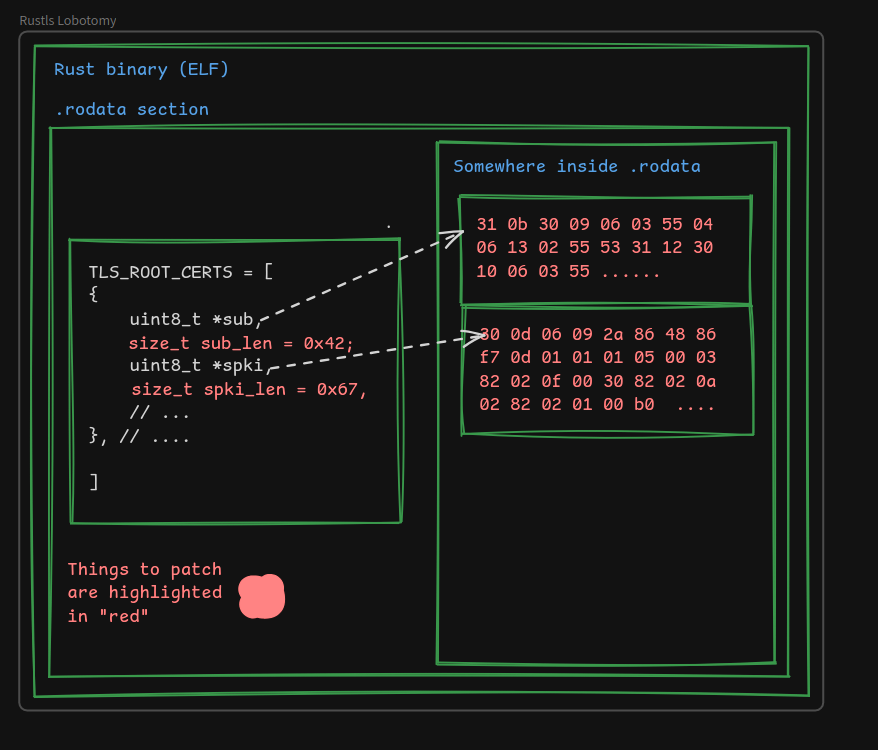
Rustls does not uses the underlying OS’s certificate store for verifying certificates. It instead embeds it’s copy of root CA’s into the binary itself (in the variable TLS_SERVER_ROOTS).
To inject our web proxy’s CA Cert into the application’s CA Database, we just have to patch the subject and subject_public_key_info bytes, and their length fields.
The below diagram is a rough representation of what we’ll be doing:
Patching subject and subject_public_key_info
Patching the subject and subject_public_key_info is as simple as a bytes.replace invocation in python - with added padding.
Padding is needed to ensure that the virtual address offsets inside the target binary stays valid even after patching the binary.
Patching the length of subject and subject_public_key_info
The rust type of the subject and subject_public_key_info fields is &[u8], which has the following C struct layout:
C
1
2
3
4
structsliceOfu8{uint8_t*buf;// this points to the `.rodata` section
size_t*len;// this is the length of the buf
}
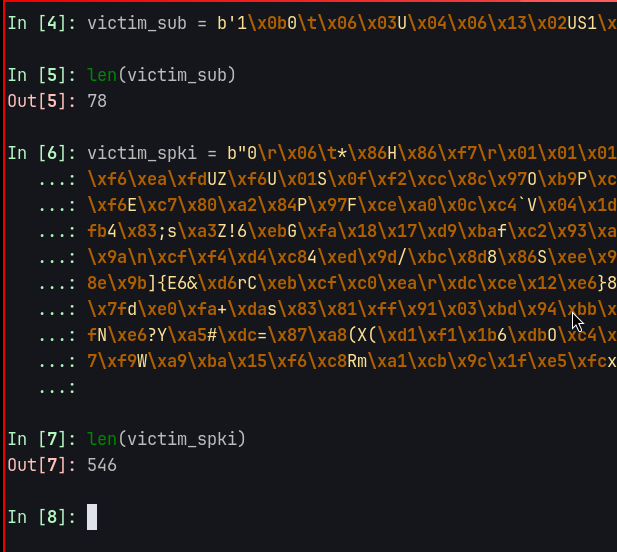
If our proxy’s CA cert is of the same length as the victim CA Cert, there is no need to patch the len field. But it is not always the case - so the length field has to be corrected.
In order to find the appropriate offsets, open the binary in your favorite reverse engineering tool. I will use ghidra.
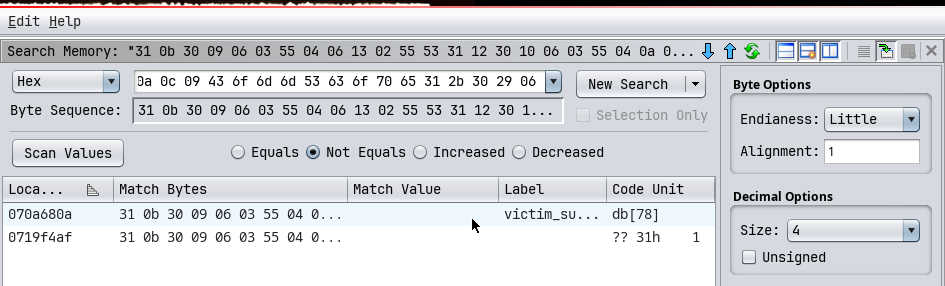
Then, do a byte sequence search of your victim subject and spki, to find the PIE Offsets.
Surprisingly, it contains not one but two results - which means we should replace every single occurence.
The result contains the following PIE Offsets:
TEXT
0x070a680a
0x0719f4af
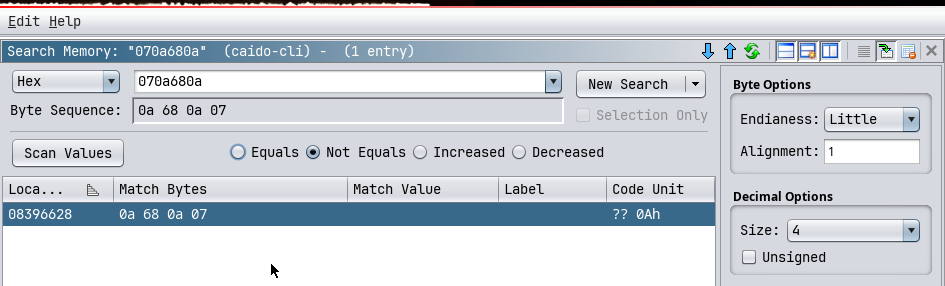
Start a second search with this RVA as the search query
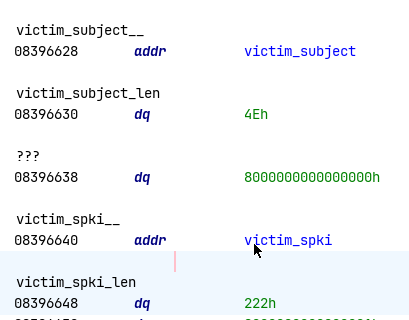
Navigate to the location in ghidra, and replicate the layout of the sliceOfu8 struct.
Verify the discovered length with the length in the source code:
Copy the Bytesource Offsets of the two lengths which will be used for patching later.
PY
1
2
3
4
5
6
victim_spki_len_loc=0x8096648victim_sub_len_loc=0x8096630# We use the unpadded length here.elf_bytes[victim_spki_len_loc:][:8]=p64(len(proxyca_spki))elf_bytes[victim_sub_len_loc:][:8]=p64(len(proxyca_sub))
fromshleximportquotefrompwnimport*fromcryptographyimportx509fromcryptography.hazmat.primitivesimportserializationproxy_ca=args.PROXY_CAor"./caido.pem"caido_cli_elf=args.ORIGor"./caido-cli"patched_elf=args.PATCHEDor"./caido-cli-patched"# Patch victim subjectvictim_sub=b'1\x0b0\t\x06\x03U\x04\x06\x13\x02US1\x120\x10\x06\x03U\x04\n\x0c\tCommScope1+0)\x06\x03U\x04\x03\x0c"CommScope Public Trust RSA Root-01'# Patch victim spkivictim_spki=b"0\r\x06\t*\x86H\x86\xf7\r\x01\x01\x01\x05\x00\x03\x82\x02\x0f\x000\x82\x02\n\x02\x82\x02\x01\x00\xb0He\xa3\r\x1dB\xe3\x91m\x9d\x84\xa4a\x96\x12\xc2\xed\xc3\xda#4\x19v\xf6\xea\xfdUZ\xf6U\x01S\x0f\xf2\xcc\x8c\x97O\xb9P\xcb\xb3\x01DV\x96\xfd\x9b(\xec{t\x0b\xe7BkU\xce\xc9a\xb2\xe8\xad@<\xba\xb9A\n\x05O\x1b&\x85\x8fC\xb5@\xb5\x85\xd1\xd4q\xdc\x83A\xf3\xf6E\xc7\x80\xa2\x84P\x97F\xce\xa0\x0c\xc4`V\x04\x1d\x07[F\xa5\x0e\xb2K\xa4\x0e\xa5|\xee\xf8\xd4b\x03\xb9\x93j\x8a\x14\xb8p\xf8.\x82F8#\x0et\xc7kA\xb7\xd0)\xa3\x9d\x80\xb0~w\x93cB\xfb4\x83;s\xa3Z!6\xebG\xfa\x18\x17\xd9\xbaf\xc2\x93\xa4\x8f\xfc]\xa4\xad\xfcPj\x95\xac\xbc$3\xd1\xbd\x88\x7f\x86\xf5\xf5\xb2s*\x8f|\xaf\x08\xf2\x1a\x98?\xa9\x81e?\xc1\x8c\x89\xc5\x960\x9a\n\xcf\xf4\xd4\xc84\xed\x9d/\xbc\x8d8\x86S\xee\x97\x9f\xa9\xb2c\x94\x17\x8d\x0f\xdcf*|RQu\xcb\x99\x8e\xe8=\\\xbf\x9e;(\x8d\x83\x02\x0f\xa9\x9fr\xe2,+\xb3\xdcf\x97\x00@\xd0\xa4T\x8e\x9b]{E6&\xd6rC\xeb\xcf\xc0\xea\r\xdc\xce\x12\xe6}8\x9f\x05'\xa8\x97>\xe9Q\xc6l\x05(\xc1\x02\x0f\xe9\x18m\xec\xbd\x9c\x06\xd4\xa7I\xf4T\x05kl0\xf1\xeb\x03\xd5\xea=jv\xc2\xcb\x1a(IM\x7fd\xe0\xfa+\xdas\x83\x81\xff\x91\x03\xbd\x94\xbb\xe4\xb8\x8e\x9c2c\xcd\x9f\xbbh\x81\xb1\x84[\xaf6\xbfw\xee\x1d\x7f\xf7I\x9bR\xec\xd2wZ}\x91\x9dM\xc29-\xe4\xba\x82\xf8o\xf2N\x1e\x0fN\xe6?Y\xa5#\xdc=\x87\xa8(X(\xd1\xf1\x1b6\xdbO\xc4\xff\xe1\x8c[r\x8c\xc7&\x03'\xa39\n\x01\xaa\xc0\xb21`\x83\"\xa1O\x12\t\x01\x11\xaf4\xd4\xcf\xd7\xaeb\xd3\x05\x07\xb41u\xe0\rmWOi\x87\xf9W\xa9\xba\x15\xf6\xc8Rm\xa1\xcb\x9c\x1f\xe5\xfcx\xa85\x9a\x9fA\x14\xce\xa5\xb4\xce\x94\x08\x1c\t\xadV\xe5\xda\xb6I\x9aJ\xeac\x18S\x9c,.\xc3\x02\x03\x01\x00\x01"# WARN: SlopGen'ddefstrip_der_tlv(der:bytes)->bytes:"""
Strip the outer ASN.1 DER TLV and return the VALUE.
Assumes the object is a single TLV (e.g., SEQUENCE).
"""iflen(der)<2:raiseValueError("DER too short")tag=der[0]iftag!=0x30:raiseValueError(f"Unexpected DER tag: {tag:#x}")first_len=der[1]# Short form lengthiffirst_len<0x80:length=first_lenheader_len=2else:# Long form lengthnum_len_bytes=first_len&0x7Fifnum_len_bytes==0ornum_len_bytes>4:raiseValueError("Invalid DER length encoding")length=int.from_bytes(der[2:2+num_len_bytes],"big")header_len=2+num_len_bytesvalue=der[header_len:header_len+length]iflen(value)!=length:raiseValueError("DER length mismatch")returnvaluedefget_subject_spki(pem_path):withopen(pem_path,"rb")asf:pem_data=f.read()cert=x509.load_pem_x509_certificate(pem_data)subject=cert.subject.public_bytes(serialization.Encoding.DER)subject=strip_der_tlv(subject)spki=cert.public_key().public_bytes(encoding=serialization.Encoding.DER,format=serialization.PublicFormat.SubjectPublicKeyInfo,)spki=strip_der_tlv(spki)return(subject,spki)proxyca_sub,proxyca_spki=get_subject_spki(proxy_ca)assertlen(victim_sub)>=len(proxyca_sub)assertlen(victim_spki)>=len(proxyca_spki)proxyca_sub_padded=proxyca_sub+b"\x00"*(len(victim_sub)-len(proxyca_sub))proxyca_spki_padded=proxyca_spki+b"\x00"*(len(victim_spki)-len(proxyca_spki))caido_bytes=bytearray(read(caido_cli_elf))caido_bytes=caido_bytes.replace(victim_sub,proxyca_sub_padded)caido_bytes=caido_bytes.replace(victim_spki,proxyca_spki_padded)victim_spki_len_loc=0x8096648victim_sub_len_loc=0x8096630info("before patching sub length - spki: %#x"%u64(caido_bytes[victim_sub_len_loc:][:8]))info("before patching spki length - sub: %#x"%u64(caido_bytes[victim_spki_len_loc:][:8]))caido_bytes[victim_spki_len_loc:][:8]=p64(len(proxyca_spki))caido_bytes[victim_sub_len_loc:][:8]=p64(len(proxyca_sub))info("after patching sub length - spki: %#x"%u64(caido_bytes[victim_sub_len_loc:][:8]))info("after patching spki length - sub: %#x"%u64(caido_bytes[victim_spki_len_loc:][:8]))write(patched_elf,bytes(caido_bytes))os.system("chmod +x %s"%(quote(patched_elf)))
Conclusion
This technique applies to any Rust project that relies on rustls for TLS. If a project uses a different TLS stack, binary patching may not be necessary at all. Understanding the underlying architecture is essential when attempting to bypass these protections.